
Best Free Math Games for Kids Online: No App, No Signup
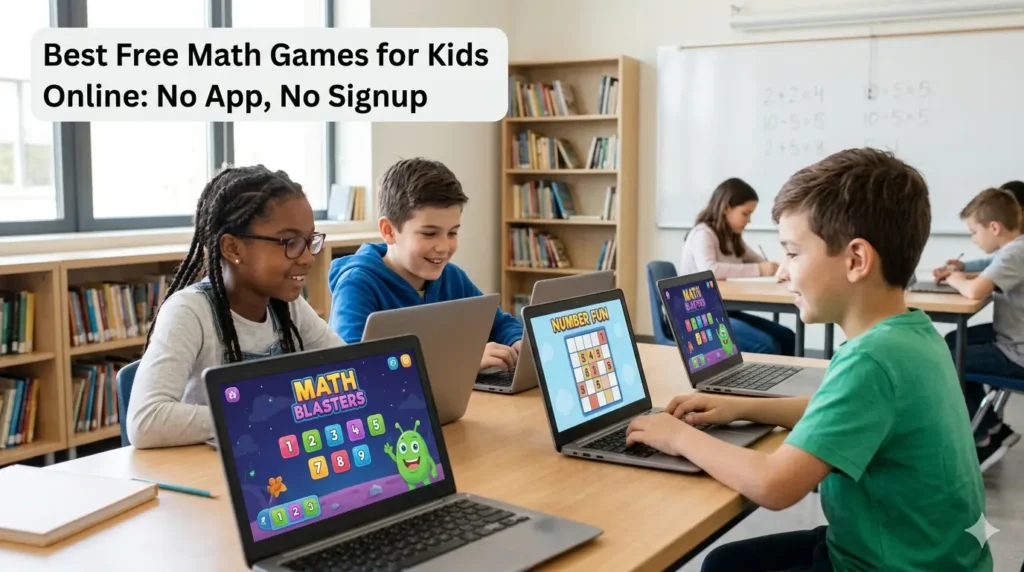
Most kids do not wake up excited about math. But most kids also do not realize they are doing math when they are racing against a timer, figuring out a number pattern, or trying to beat their own high score. The right game makes all the difference.
This list covers the best free math games for kids available right now on EduDu. Every game here runs in your browser with no download and no account required. You can be playing in under ten seconds. They range from games for young kids still learning to count, all the way to games that will genuinely challenge older students who think they have math figured out.
For Young Kids (Ages 5 to 8)
Kobadoo Numbers

This is where most younger kids should start. Kobadoo Numbers focuses on number recognition and basic ordering in a clean, distraction-free environment. The interface is simple enough that a five-year-old can navigate it independently, and the game gives clear feedback so kids know immediately when they are right or wrong. No reading required, which matters for the youngest players.
What makes it work is the pacing. It does not overwhelm kids with too much on screen at once. One task, one number, immediate feedback. For a child who is still building confidence with numbers, that simplicity is everything.
Kobadoo Shapes

Shapes might not feel like math, but spatial awareness and shape recognition are foundational to geometry, measurement, and visual reasoning. Kobadoo Shapes presents shapes and asks kids to identify and match them quickly. The visual design is bright and friendly without being chaotic, and the difficulty scales gently so kids are always slightly challenged without being frustrated.
Teachers use this one as a warm-up before geometry lessons. Parents use it as a quick activity that does not feel like homework.
For Middle Ages (Ages 8 to 12)
Kobadoo Arithmetic

This is the one kids come back to. Kobadoo Arithmetic presents arithmetic problems addition, subtraction, multiplication and you have to answer before the timer runs out. As you get faster, the game gets harder. That loop of improving your own score is genuinely motivating in a way that a worksheet simply is not.
It is also honest about difficulty. The game does not pretend everything is easy. If you are slow on your multiplication tables, Kobadoo Arithmetic will find that out quickly and make you practice. In the best possible way.
Teachers who use this as a five-minute classroom warm-up report that kids actually request it. That says everything.
Play Kobadoo Arithmetic on EduDu
Master of Numbers

Master of Numbers takes a different approach. Rather than testing calculation speed, it focuses on number patterns, sequences, and recognition. The game asks you to process numbers visually and quickly, which builds a different kind of mathematical thinking than arithmetic alone.
This is a good one for kids who are strong at mental math but struggle with pattern recognition, or vice versa. It fills a gap that most math games ignore.
Play Master of Numbers on EduDu
Lipuzz Water Sort Puzzle

This one might surprise you on a math games list, but hear it out. Sorting and categorization are core mathematical skills. Lipuzz Water Sort Puzzle asks you to sort colored liquids into matching tubes, which requires you to plan several moves ahead, think about sequences, and work out cause and effect. That is mathematical thinking, even if no numbers are involved.
It is also genuinely relaxing, which makes it a good option for a kid who is frustrated after struggling with actual arithmetic. It builds the underlying thinking skills without the pressure.
Play Lipuzz Water Sort Puzzle on EduDu
For Older Kids (Ages 10 and Up)
Puzzlebot
Puzzlebot introduces sequencing and logical reasoning through a robot puzzle game. You plan a series of moves to get the robot to its destination, which requires thinking in exactly the way algebra and early computer science demand. It never uses math vocabulary but it builds math thinking in a way that sticks.
Older kids who find number games too easy often get hooked on this one because it challenges them differently. It rewards patience and systematic thinking over speed.
Cut the Rope

Physics is math in motion. Cut the Rope teaches gravity, trajectory, timing, and cause and effect through a game about feeding candy to a small creature. Players who get good at Cut the Rope are intuitively building an understanding of how forces work together, which is exactly the thinking that underpins physics and applied mathematics later on.
It is also just an excellent game by any measure, which is why it has been played billions of times since it launched.
What Makes a Math Game Actually Good
There are thousands of so-called math games online and most of them are terrible. They slap a few arithmetic questions onto a thin game mechanic and call it educational. Kids see through this immediately and lose interest within minutes.
The games on this list work because the math is built into the game itself rather than bolted on top. When you are racing a timer in Kobadoo Arithmetic, the pressure is part of the learning. When you are planning sequences in Puzzlebot, the logic is the game. That is the difference between a game kids will play once and a game they come back to.
A Note for Parents and Teachers
Every game on this list is free, runs in any modern browser, and requires no account or download. They work on school computers, tablets, and home laptops equally well. None of them contain in-app purchases.
If you are a teacher looking for a quick activity before a math lesson, Kobadoo Arithmetic and Master of Numbers are the easiest to use because they require no explanation, kids pick them up in under a minute. If you are a parent looking for something that builds thinking skills without feeling like extra homework, start with Lipuzz or Cut the Rope.
Either way, you are in the right place.
Explore all free games at Edudu.org.