
10 Free Educational Games for Kids Ages 6 to 10
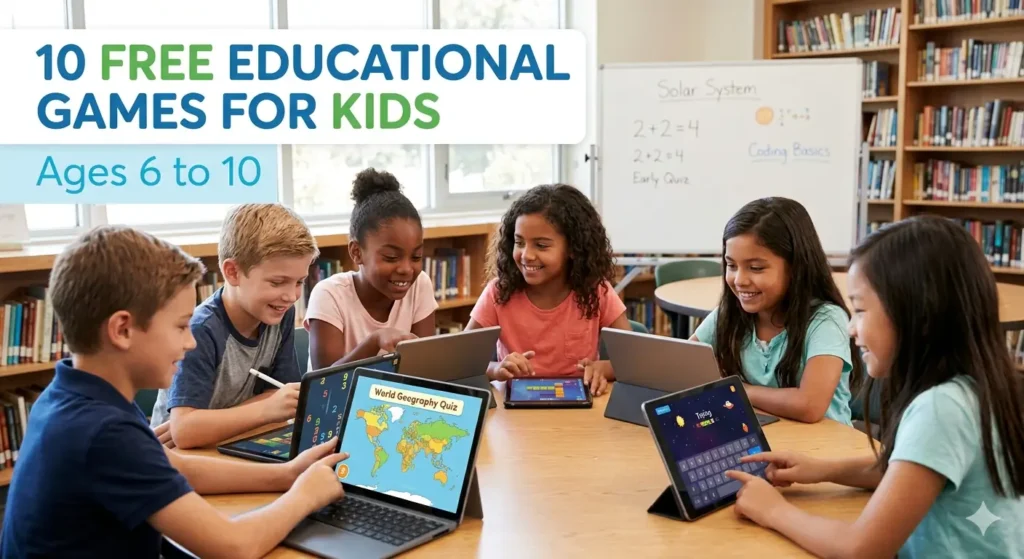
Finding genuinely good educational games for young kids is harder than it should be. Most results either require an app download, a paid subscription, or turn out to be thinly disguised worksheets with game graphics slapped on top. Kids see through that immediately and lose interest within minutes.
This list is different. Every game here is free, runs directly in your browser, and requires no account or download. More importantly, every one of them is something kids actually want to play. They build real skills in math, geography, logic, memory, and spatial thinking without ever feeling like schoolwork.
They are all available right now on EduDu.
1. Kobadoo Numbers

The best starting point for kids who are still getting comfortable with numbers. Kobadoo Numbers focuses on number recognition and basic ordering in a clean interface with no distractions. One task at a time, immediate feedback, gentle pacing. A five year old can navigate it independently after about thirty seconds of looking at the screen.
What parents and teachers love about it is that it does not talk down to kids. The design is simple because simplicity is appropriate, not because it assumes kids cannot handle anything challenging. The difficulty increases naturally as kids improve.
Best for ages 5 to 8.
2. Kobadoo Shapes

Shapes are the foundation of geometry, measurement, and spatial reasoning. Kobadoo Shapes presents shapes on screen and asks kids to identify and match them quickly. The visual design is bright and friendly and the pace is well calibrated for younger players.
It works particularly well as a pre-lesson warmup before any activity involving geometry or visual patterns. Kids arrive at the lesson having already been thinking in the right way.
Best for ages 5 to 9.
3. Kobadoo Arithmetic

This is the one kids come back to most. Kobadoo Arithmetic presents arithmetic problems and you have to answer before the timer runs out. The pace increases as you get faster, which keeps even confident math students engaged rather than bored.
The competitive element is what makes it stick. Kids want to beat their own score. That motivation to improve is exactly what makes the difference between a skill that develops and one that stays flat. Teachers who use this as a five minute classroom warmup report that students ask for it by name.
Best for ages 7 to 12.
Play Kobadoo Arithmetic on EduDu
4. Kobadoo Flags

World flags is one of those topics that kids either love or have never been introduced to properly. Kobadoo Flags shows a flag and gives four country options to choose from. It starts with well known nations and gradually introduces less familiar ones as you progress.
The geography knowledge it builds is genuinely useful and the game format makes it feel like a quiz show rather than a lesson. Many kids who play it end up looking up more information about the countries they did not recognize, which is exactly the kind of curiosity a good game should spark.
Best for ages 8 to 12.
5. Master of Numbers

Where Kobadoo Arithmetic tests calculation speed, Master of Numbers focuses on number patterns and sequences. These are different cognitive skills and both matter. A child who is fast at arithmetic but struggles with patterns will find this game genuinely challenging in a productive way.
The visual design keeps kids focused and the difficulty curve is honest. It does not pretend everything is easy. That honesty is important because it teaches kids that getting better at something requires real effort.
Best for ages 7 to 11.
Play Master of Numbers on EduDu
6. Match Mystery

Match Mystery is a memory game with an extra layer. Rather than matching identical pairs, players match related concepts. This builds associative thinking alongside memory, which is a richer cognitive exercise than simple card matching.
In a classroom setting it works brilliantly as a discussion tool. When two cards match, a teacher can ask students to explain the connection. That moment of explanation is where understanding moves from surface level to genuine.
Best for ages 6 to 10.
7. Fish Love

Fish Love is a gentle physics puzzle game where you need to get two fish together by manipulating water levels and removing obstacles. Each level is a self-contained problem with a satisfying solution.
What makes it appropriate for younger kids is the tone. It is warm, patient, and never punishing. If you get stuck, there is no timer counting down and no harsh failure screen. It just waits for you to think it through. That low-pressure environment makes it ideal for kids who are still building confidence in problem solving.
Best for ages 6 to 9.
8. Cut the Rope

Cut the Rope is one of the most played browser games in the world for good reason. The physics are satisfying, the levels are inventive, and the difficulty increases at exactly the right pace to keep kids in the sweet spot between easy and frustrating.
For educational purposes it teaches physics concepts intuitively, gravity, momentum, and cause and effect, without using any of those words. Kids who have played Cut the Rope extensively tend to have a much stronger instinctive understanding of how forces interact, which shows up later in science lessons.
Best for ages 7 and up.
9. Awareness Game: The Robot Bar

Observation is a skill that rarely gets taught directly but matters enormously. The Awareness Game asks you to look carefully at a scene and identify what has changed or does not belong. It is harder than it sounds because it exposes just how much we miss when we look at things without really seeing them.
For kids aged 8 to 10 this is one of the most valuable games on this list. Strong observation skills feed directly into reading comprehension, scientific thinking, and social awareness. And unlike many skills, observation is trainable with relatively little effort.
Best for ages 8 to 12.
10. Puzzlebot
Puzzlebot saves the best for last. You plan a sequence of moves to guide a small robot through increasingly complex levels. Get the sequence right and the robot succeeds. Get it wrong and you try again with new information.
What this teaches, without ever saying so, is computational thinking: the ability to break a complex problem into ordered steps and execute them correctly. This is the foundational skill behind coding, engineering, mathematics, and organized thinking of any kind. For a child aged 8 to 10 who is ready to be challenged, this is the most rewarding game on the list.
Best for ages 8 and up.
A Note for Parents and Teachers
All ten games above are completely free, require no account or download, and work on any modern browser including the ones found on school computers. None contain in-app purchases or age-inappropriate content.
If you are a teacher looking for a quick activity, Kobadoo Arithmetic and Kobadoo Numbers are the easiest to drop into a lesson because they need no explanation. If you are a parent looking for something your child will actually choose to play, start with Cut the Rope or Fish Love and let them discover the others naturally.
The best learning happens when kids do not realize they are learning. Every game on this list understands that.
Explore all free games at EduDu.org.